
Saying something wrong is so common in the world of politics that it barely registers after a while — we become inured.
But the other day, I heard for the first time this whopper from a leader in the current administration, someone who unfortunately heads one of the most important agencies in US healthcare1:
Why does this statement — that AZT was “killing people”, or even “killed more people than AIDS” — bother me so much? It’s because I watched firsthand back in the 1980s what was happening with this still-new disease, and the way it horribly took the lives of so many young people in our country. So let’s set the record straight.
You see, HHS secretary, I was a medical resident in the late 1980s, a time when AIDS cases were increasing rapidly in this country and treatments were unbelievably limited. The prognosis for someone newly diagnosed with AIDS was grim, with a median survival of around 18 months after an opportunistic infection (OI).
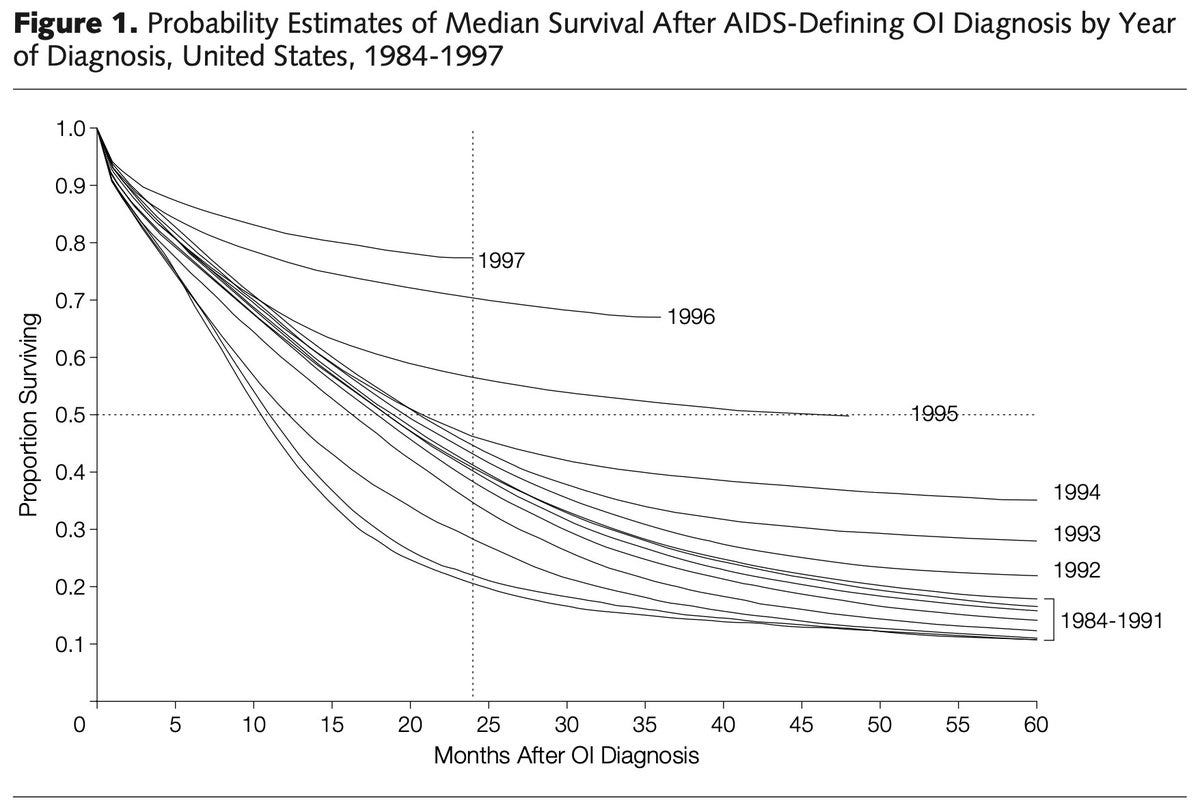
Less than two years! For a condition predominantly striking young people, that’s just a staggering tragedy, one that was unfolding on a national and global scale. Newspaper obituaries were filled with adults in their prime, usually dying of an undisclosed cause. When you speak with gay men who lived through this period, they all have horror stories of their social group’s decimation from this terrifying virus.
We had one drug during my residency to treat AIDS — and it was AZT.2 The FDA approved it rapidly because a placebo-controlled, randomized clinical trial — the highest level of medical evidence — showed it reduced the risk of death in people with AIDS.
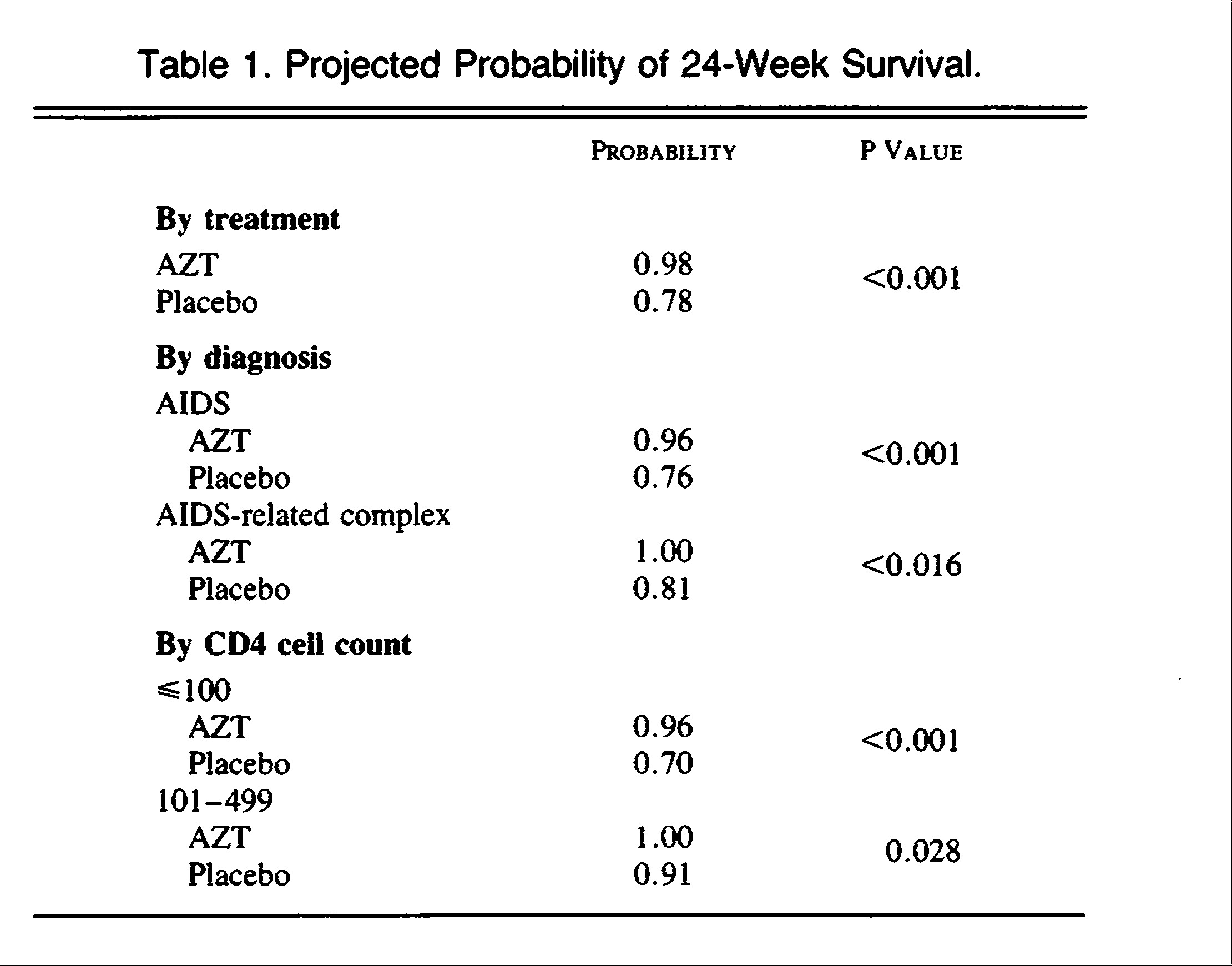
Note how all the 24-week survival outcomes significantly favored the AZT group over those who received placebo, regardless of baseline characteristics. A p value of <0.001 means the result is extremely unlikely to be a fluke — less than a 1 in 1,000 chance — if the treatment truly had no effect.
Further evidence that the treatment was effective came from the study’s early termination. Every clinical trial has, before it starts, a group of experts in the field overseeing the conduct of the study and reviewing its data. Their primary responsibility is participant safety. And this panel stopped this study early because of the marked imbalance in deaths between the AZT and the placebo group:
Before the study began, an independent board was established to review the study data for unacceptable toxicity or unequivocal benefit. The study was terminated prematurely because there was a significant difference in mortality between the AZT and placebo recipients …
Nineteen subjects in the placebo group and 1 in the AZT group died during the study (P<0.001).
It was so much better than nothing!
Of course AZT was far from perfect. At the original dose chosen for this clinical trial — 250 mg every 4 hours! — it not only required obsessive scheduling by the patients (they set alarms to wake themselves at night), it also caused nausea, headaches, and sometimes severe anemia. Even after studies showed we could safely reduce the dose to 200 mg three times a day, some people had these side effects.
Moreover, its beneficial effects were temporary. Like virtually every infectious disease, continuous treatment commonly led to resistance, and this proved to be AZT’s Achilles’ heel — as a single drug, it didn’t work for very long.
As a result, despite the availability of AZT and a couple of other drugs like it, by the time I completed my subspecialty training in Infectious Diseases, AIDS had become a leading cause of death among young adults in the United States — and the #1 cause among men.
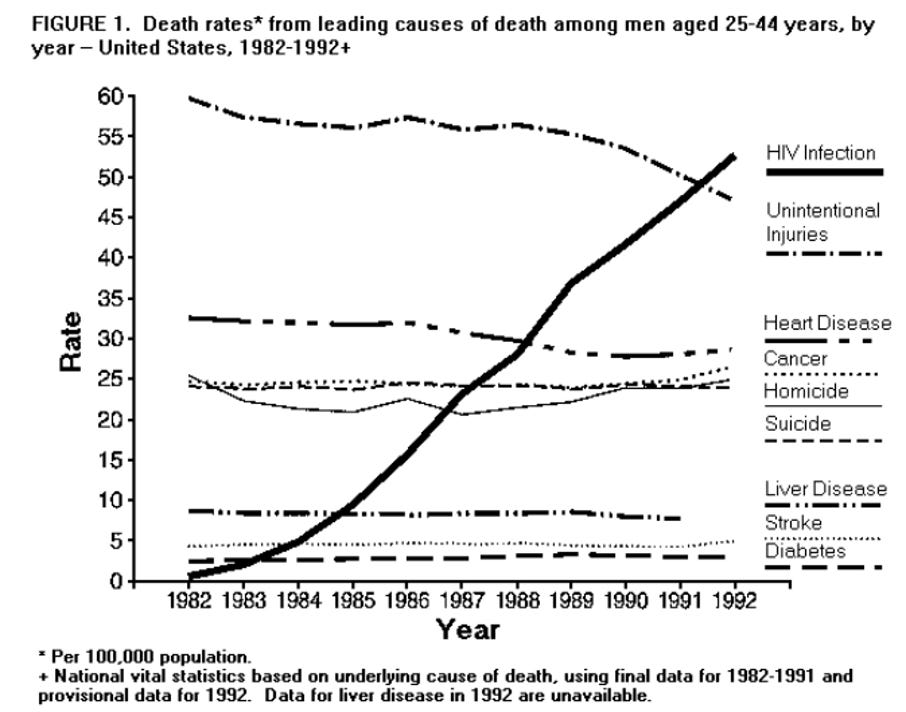
Yes, these poor patients were dying even though many of them took AZT. But blaming AZT for their deaths is the laziest form of thinking — it’s like blaming insulin for causing the deaths of people with diabetes, or saying that ice cream sales cause shark attacks each summer.

Let’s now skip ahead to 1996, a year that will forever be etched in the memories of people with HIV living at the time, and those of us caring for them. We see something quite striking, and exciting: A combination of three HIV drugs — including AZT — literally stopped the virus from reproducing:
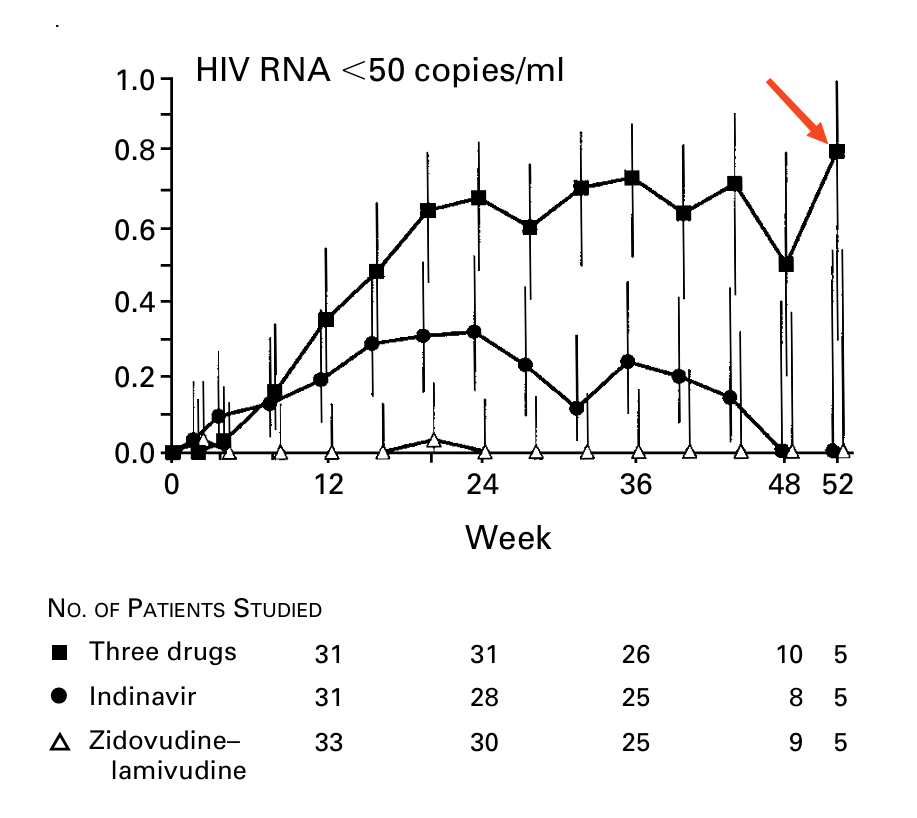
See that “three drug” treatment arm, with 80% of participants having HIV RNA < 50 copies/mL after a whole year of treatment? The virus was now “undetectable” in the blood, the term most commonly used today in clinical practice. That means the investigators found no evidence of the virus replicating (reproducing) in four out of five study participants — the combination completely blocked it.
And once the treatments were this potent, suppressing virus replication, the risk of resistance fell dramatically. Now, HIV therapy could work indefinitely — which, amazingly, it has!
My favorite essay from this magical year was an account in the New York Times by Andrew Sullivan, called “When Plagues End” (gift link).
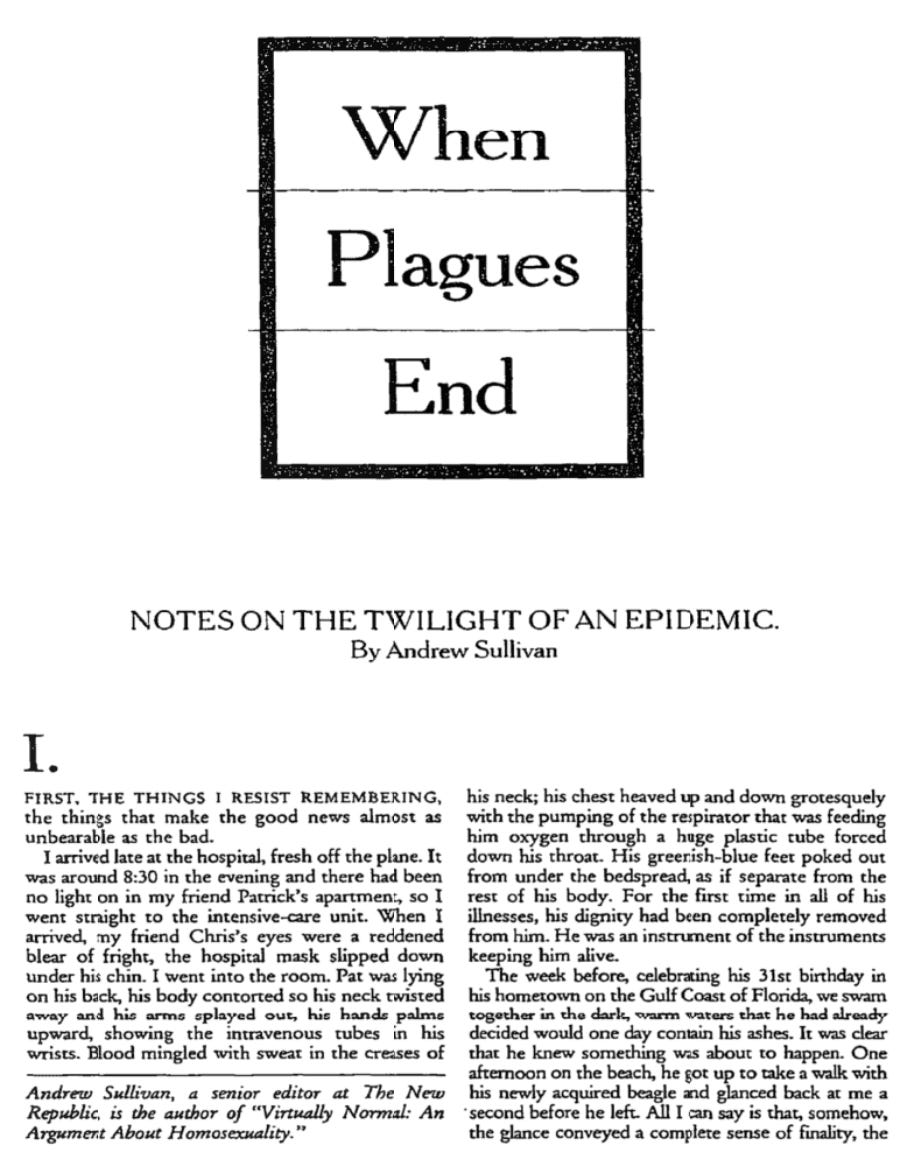
Sullivan gave a first-hand account of what it was like watching so many of his friends get sick and die from AIDS; his descriptions are frighteningly accurate, harrowing even. Yet in writing this piece in 1996, seeing for the first time treatments that fully suppressed the virus, he had the sudden realization that people with HIV might live after all — including himself.
In the past six months, I have begun to believe I will live a normal life. By normal, of course, I don't mean without complications. I take 23 pills a day — large cold pills I keep in the refrigerator, pills that, until very recently, made me sick and tired in the late afternoon. But normal in the sense that mortality, or at least the insistence of mortality, doesn't hold my face to the wall every day. I mean I live with the expectation that life is not immediately fragile; that if I push it, it will not break.
It is a strange feeling this, and a little hard to communicate. When you have spent several years girding yourself for the possibility of death, it is not so easy to gird yourself instead for the possibility of life.
It’s such a powerful essay I highly recommend it as a critical piece in the history of medicine. Reading it again today gave me chills. And, for the record, most people today can be treated with a single pill, once-daily. Progress!
For full transparency: AZT very rarely caused fatal toxicity, most often related to mitochondrial injury and lactic acidosis — a risk that was uncommon and became even rarer as dosing improved.3
So this statement that AZT caused more deaths than AIDS is so flagrantly wrong that it’s worth asking where it comes from, aside from the common error of mistaking correlation for causation. Was it the side effects? The fact that it wasn’t a cure? That the cost of the drug was too high?
This myth persists because it speaks to a certain kind of cynicism: the idea that medicine is mostly harm dressed up as help, that experts are fools or liars or in the pocket of the pharmaceutical industry (or some combination of the three), and that evidence published in peer-reviewed scientific journals is all a big con. AZT here becomes a convenient villain — an imperfect drug from an imperfect era — stripped of its historical context and recast as evidence of systemic failure, one that could have been “solved” by letting the front-line clinicians cited in the video lead the research.
But AZT did not kill more people than AIDS. AIDS was killing people at an appalling rate long before AZT existed, and it continued to do so until combinations of drugs — an approach built directly on the foundation AZT provided — finally stopped the virus in its tracks.
To erase that reality is an insult to the patients who swallowed pills every four hours, set alarms in the middle of the night, endured side effects, and still volunteered for clinical trials because something was better than nothing.
Many of them are alive today because of that choice.
Medicine advances the way most human endeavors do: incrementally, imperfectly, and with course corrections along the way. Pretending that early steps were acts of mass harm rather than hard-won progress is outrageously wrong.
As I wrote in the subtitle, it’s enough to make your head explode.
I don’t like to type-out his name. Too painful.
AZT has had a bunch of other names over the years including zidovudine (abbreviated ZDV) and the brand-name Retrovir. Yes, Learning the Names of HIV Drugs Is Horribly Difficult.
In my entire career, with decades of experience seeing patients with HIV, including many on AZT, I only saw one case where AZT-induced lactic acidosis was the primary cause of death.
Powerful post Paul. Please keep repelling the lies and anti-science thinking spewed by this horrific HHS regime. Hopefully your truth will reach more and more fellow Americans and help them protect themselves.
Ah Paul what a trip down memory lane…Margaret Fischl 1st author on the first piece and Trip Gulick on the second. And when I reflect on the journey (still ongoing of course) I feel very proud and grateful to be part of it.